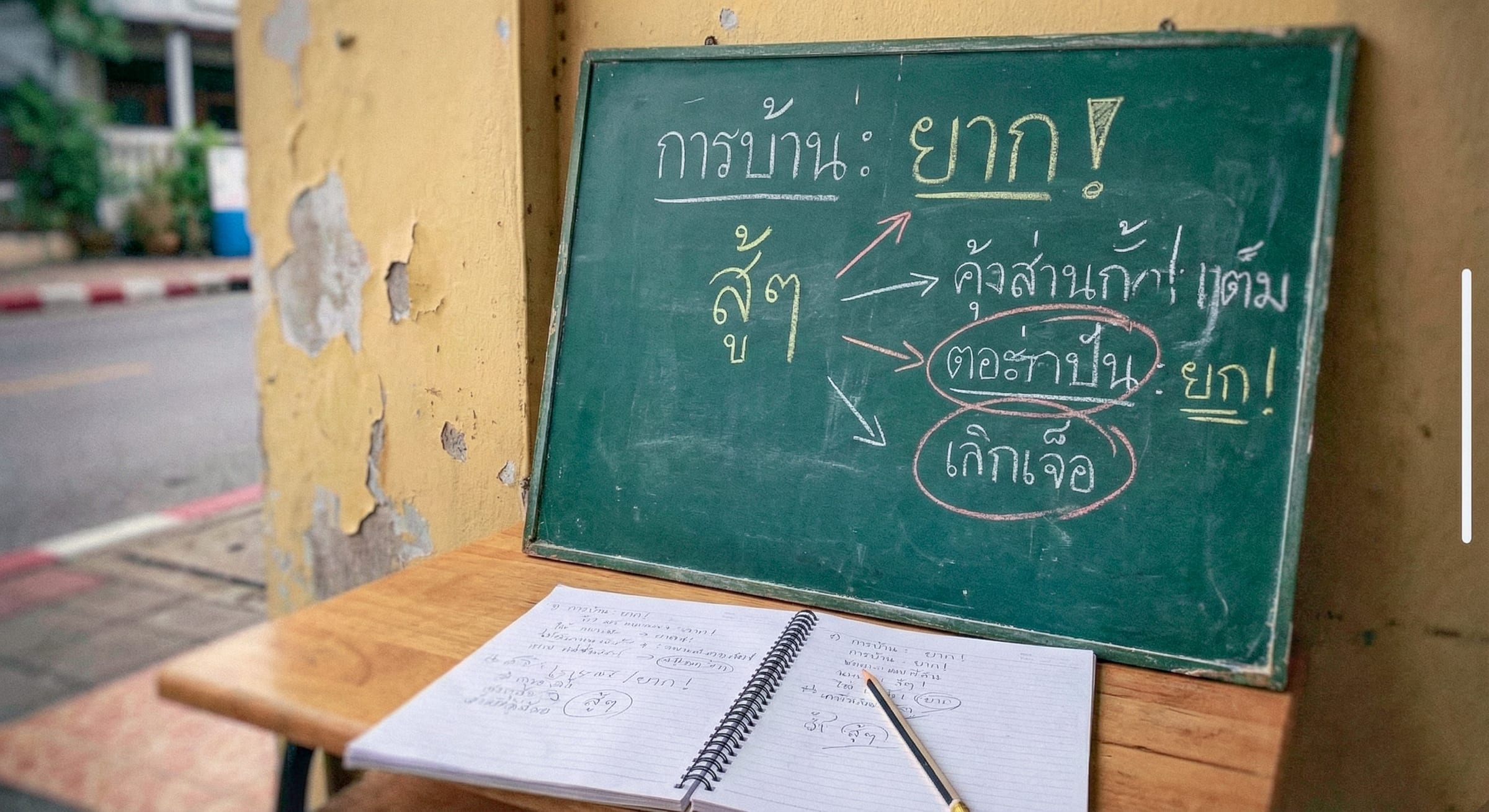
Is Thai Hard to Learn?
The honest answer: it depends on where you're coming from. Here's what actually makes Thai challenging—and what's easier than you'd expect.
Daniel Reyes
Talk Thai Team
The Short Answer
Yes and no. Thai is harder than Spanish for an English speaker. But it’s not as hard as Mandarin, and it’s definitely not impossible.
The US Foreign Service Institute (FSI) classifies Thai as a “Category III” language—meaning it takes roughly 1,100 hours of study to reach professional working proficiency. For comparison, Spanish is Category I (600 hours) and Mandarin is Category IV (2,200 hours).
But here’s the thing: those numbers assume you’re learning in a classroom. If you’re living in Thailand, surrounded by the language, you can cut that time dramatically.
What Makes Thai Challenging
1. The Tones
Thai has five tones: mid, low, falling, high, and rising. The same syllable pronounced with different tones means completely different things.
Example: “mai” can mean:
- ไหม (rising) — question particle
- ใหม่ (low) — new
- ไม่ (falling) — no/not
- ไม้ (high) — wood
- ไหม้ (high) — to burn
This is genuinely hard for English speakers because English uses tone for emotion, not meaning. You’ll mess this up for months. That’s normal.
We break all five tones down — including the rules that let you predict them — in Thai Tones Explained.
2. The Script
44 consonants. 32 vowels. Vowels that can appear above, below, before, or after consonants. No spaces between words.
It looks intimidating. But here’s the secret: Thai script is actually more consistent than English spelling. Once you learn the rules, you can read anything. There are no “through” vs “though” vs “thought” nightmares.
3. Vocabulary
Thai and English share almost no common roots. Unlike learning Spanish (where “telephone” = “teléfono”), every Thai word is completely new.
What’s Easier Than You’d Expect
1. Grammar
Thai grammar is shockingly simple:
- No conjugation. Verbs don’t change based on person, number, or tense.
- No articles. No “a” or “the” to worry about.
- No plurals. Context handles it.
“I go” and “He went” and “They will go” all use the same verb: ไป (bpai).
2. Pronunciation (Mostly)
Apart from tones, Thai sounds aren’t that foreign. There are no clicks, no impossible consonant clusters, no sounds English speakers can’t physically make.
3. Immediate Usefulness
Unlike, say, learning Latin, every word you learn in Thai is immediately useful if you’re in Thailand. You can practice at 7-Eleven, in a taxi, at a street food stall. That feedback loop accelerates learning dramatically.
That feedback loop starts on day one: 20 Thai phrases for ordering street food will get you fed tonight.
The Real Challenge
The hardest part of learning Thai isn’t the tones or the script.
It’s finding good resources.
Most apps teach formal, textbook Thai that sounds stiff and unnatural. (“สบายดีไหม” — literally nobody says this in casual conversation.) Most tutors vary wildly in quality. Most courses are either too slow or too fast.
That’s exactly why we built Talk Thai: to give you the Thai people actually speak, taught in a way that makes sense.
For a sense of how wide that gap gets, look at the Thai slang no textbook will teach you.
Bottom Line
Is Thai hard? Yes. Is it learnable? Absolutely.
If you’re living in Thailand and you put in consistent effort, you can be conversational in 6-12 months. Reading takes longer—maybe 3-6 months just for the basics—but it’s worth it.
The question isn’t whether Thai is hard. The question is whether you’re serious about learning it.
If you are, start here.