Built in
Nakhon
Sawan
A somewhat rural area where English doesn't get you very far.

01
The initial spark wasn't my own struggles with Thai. It was watching everyone around me.
I was an exchange student in Nakhon Sawan, learning Thai the traditional way—textbooks, youtube videos, apps. And everything they taught me was so formal, so stiff. Nothing people actually use in real life.
But I saw my friends—other exchange students from France, Belgium, Brazil—with no real resources at all. They couldn't order drinks at night markets. They couldn't follow family dinners. They were surrounded by a language and culture they wanted to connect with, and every resource they tried taught them the same useless phrases.
That's when it hit me: there really is nothing good out there.
สบายดีไหม?
Literally no one says this unless you're in a hyper-formal context.
ผม
Guys don't actually use this when talking about themselves.
These are textbook staples. They make you sound like someone learning Thai, not someone speaking it.
02
What Actually Works?
I knew if I was going to build an app, it couldn't be something stupid. Not "gamified" because it was fun. Not designed to make you feel good every day. I wanted to know: what actually works?
The answer, according to decades of language acquisition research, is comprehensible input—the highest amount of hearing and reading material that's just above your current level, across all modalities.
How can we get speaking that's just above your level? How can we get reading? Listening?
That became the foundation. Every feature in Talk Thai exists because it delivers comprehensible input in a different way—conversation that adapts to you, stories written for your exact level, culture content matched to what you already know.
03
The aha moment was real-time conversation.
Of course you can practice with real people. You can get tutors. But it's difficult to put yourself in situations where you might be embarrassed. And tutors are expensive.
What if we could build real-time, fluent conversation with daily life scenarios? What if you could practice ordering food, asking for directions, making small talk—anytime, without scheduling, without judgment?
I built it as a proof of concept, showed it to my friends, and then it kind of hit me.
None of them had anything cohesive to help them learn. If there's nothing good on the market... what if I could just build it myself?
So I did.
04
Initially, I just wanted to help my friends learn a language.
I didn't envision doing anything beyond that. But somewhere along the way, I built something I couldn't just keep to myself.
This is a Thai learning app. I'm not trying to be the next Duolingo. This is a curriculum built specifically for Thai—the words people actually use, the culture that's actually happening, the way people actually speak.
I truly believe this is the best way to learn Thai. Without any doubts in my mind.
I'm now a student at Cornell, but I'm still building, still improving, still adding content. Because this matters.
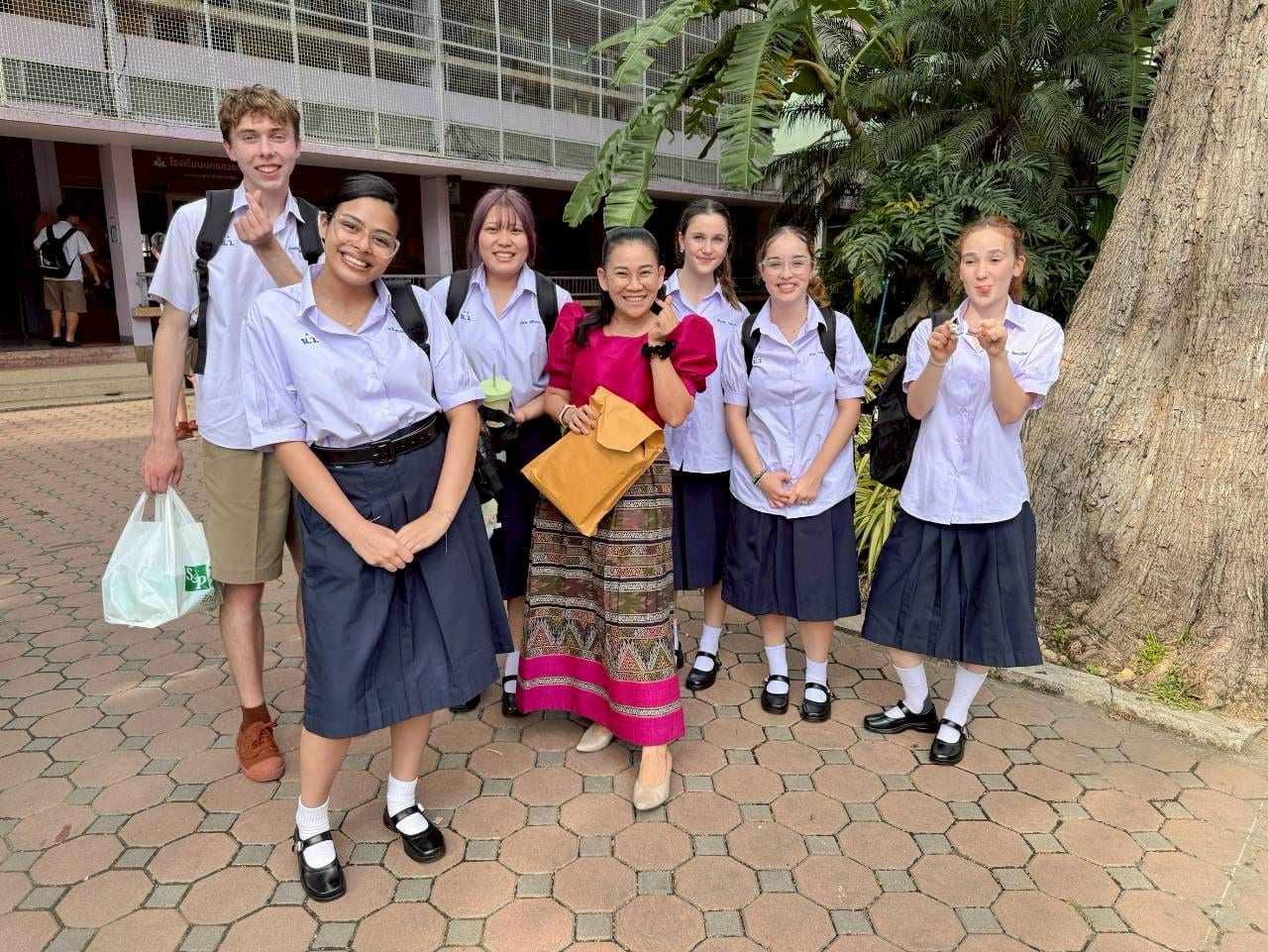
To Everyone Who Made This Possible
To แม่ยุ้ย, แม่เพชร, and แม่อ้อ—my host moms in Thailand and my first language teachers. The things you taught me are the foundations of this app.
To Marie and Justine from France, Nine from Belgium, and Maria from Brazil—my friends and the first people to test and give feedback on the development of Talk Thai. Your struggles were the inspiration. Your feedback made it better.
I'm forever thankful for my hosts, family, and friends in Thailand.
ขอบคุณครับ
Oh, and if you want recommendations: go to Chiang Rai in the North. It's one of the most authentic views of rural Thai culture—as long as you're a little adventurous with eating.