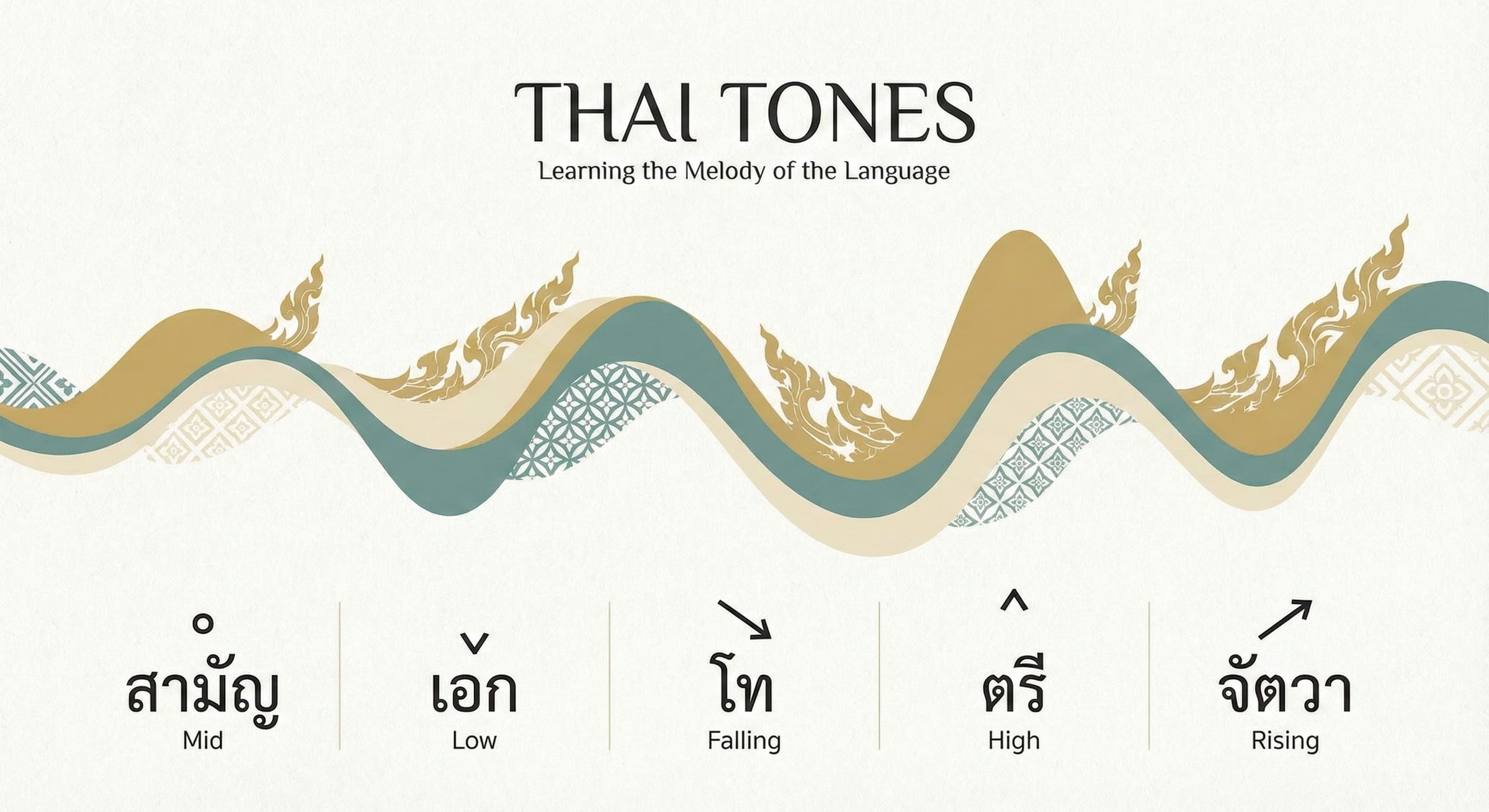
Thai Tones Explained (Without the Confusion)
Five tones. One syllable. Five different meanings. Here's how Thai tones actually work—and how to stop mixing them up.
Ploy Sirikul
Talk Thai Team
Why Tones Matter
In English, changing your tone changes how you feel. “Really?” can be sarcastic, surprised, or skeptical depending on how you say it.
In Thai, changing your tone changes what you mean. Get it wrong and you’ll say “horse” instead of “dog,” or accidentally tell someone their mom is beautiful when you meant their shirt.
Tones are the main reason people ask whether Thai is hard to learn — and the part that rewards deliberate practice fastest.
The Five Tones
1. Mid Tone (สามัญ)
Your natural speaking voice. No rise, no fall. Just… normal.
Example: กา (gaa) — crow
2. Low Tone (เอก)
Start low, stay low. Like a disappointed sigh.
Example: ใหม่ (mài) — new
3. Falling Tone (โท)
Start high, drop down sharply. Like saying “no” firmly.
Example: ไม่ (mâi) — no/not
4. High Tone (ตรี)
Higher than normal, almost strained. Like a surprised “huh?”
Example: ไม้ (mái) — wood
5. Rising Tone (จัตวา)
Start low-mid, rise up. Like asking a question in English.
Example: ไหม (mǎi) — question particle (yes/no questions)
The Classic Example: “Mai”
This is every Thai teacher’s favorite example because it demonstrates all the tones:
ไหม้ไม่ใหม่ไหม (mái mâi mài mǎi) “New wood doesn’t burn, does it?”
- ไหม้ (mái - high) — to burn
- ไม่ (mâi - falling) — not
- ใหม่ (mài - low) — new
- ไหม (mǎi - rising) — question particle
How to Practice
1. Exaggerate at First
When you’re starting out, overdo the tones. Make the high tone comically high. Make the falling tone a dramatic drop. You can always dial it back later—but if you start too subtle, you won’t learn the distinctions.
2. Listen More Than You Speak
Before you try to produce tones, train your ear to hear them. Listen to native speakers. Watch Thai TV. Use Talk Thai’s conversation mode to hear natural speech.
3. Record Yourself
Your brain lies to you. You think you’re saying the right tone, but you’re not. Record yourself, then compare to a native speaker. The difference is often shocking.
4. Learn the Tone Rules
If you can read Thai script, you can predict the tone of any word based on:
- The consonant class (high, mid, low)
- The vowel length (long or short)
- Whether there’s a final consonant
- Any tone marks
This sounds complicated, but once you internalize it, you’ll never have to guess again.
The best drill is a real one. Order dinner in Thai using these 20 street food phrases and listen to how the vendor says them back.
Common Mistakes
Mistake 1: Treating falling and high as the same Falling starts high and drops. High stays high. They’re different.
Mistake 2: Forgetting tones when speaking quickly When you speed up, your tones get sloppy. Slow down. Precision matters more than speed.
Mistake 3: Ignoring tones because “Thais will understand anyway” Sometimes they will. Sometimes they won’t. And even when they understand, you’ll sound like a struggling foreigner instead of someone who speaks Thai.
The Good News
Tones are hard at first. Then, suddenly, they click.
One day you’ll realize you’re not thinking about tones anymore—you just say them correctly. It takes practice, but it happens faster than you’d expect.
And once tones click, Thai becomes much, much easier.
Next, work on sounding like a person rather than a textbook: Thai slang you won’t find in a textbook.